
Getting Around Berkeley Without a Car: A Guide for International Students at UC Berkeley
A practical guide for incoming international students preparing for fall semester at UC Berkeley
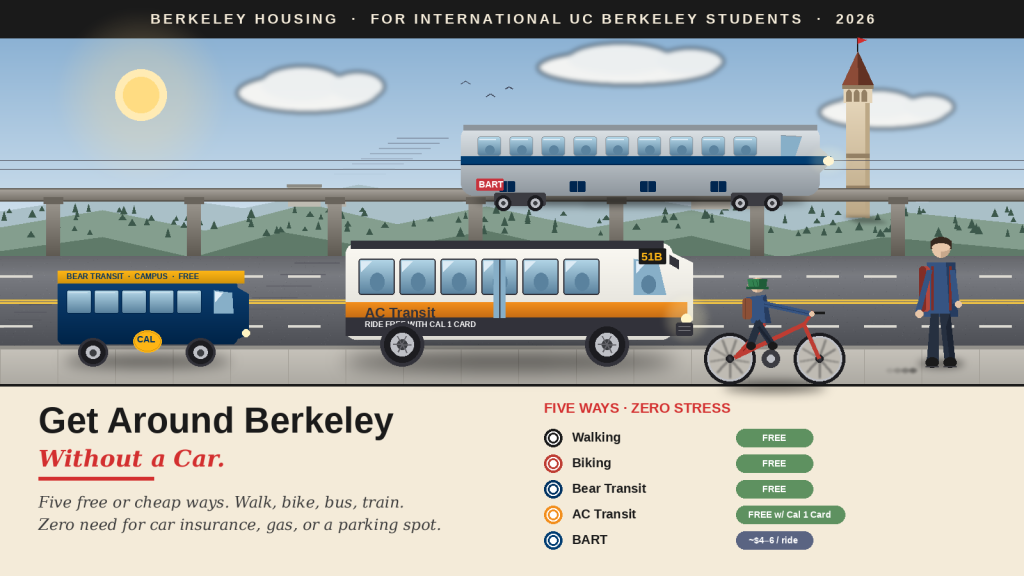
If you’re an international student arriving at UC Berkeley for the fall, the first thing to know about transportation in Berkeley is this: you almost certainly don’t need a car. Most international students at Cal go through their entire degree — undergrad or grad — without ever owning one. Berkeley is small, walkable, packed with transit, and the campus itself runs a free shuttle. The question is rarely “how do I get a car?” and almost always “what’s the smartest combination of free and cheap options to get me where I’m going?”
This guide is the answer to that question. It walks through every transportation option you’ll actually use as a student living near campus — what’s free, what’s worth paying for, when each option fits, and the practical setup steps to do before classes start.
Why most international students at Berkeley don’t need a car
A car in Berkeley costs roughly $400–700/month all-in once you account for parking, insurance, gas, registration, and depreciation — and that’s before you’ve used it for anything. Most TBG communities and similar near-campus housing are within a 1–15 minute walk of Sather Gate, the heart of campus. Most students get to class on foot, get around the city on AC Transit (free with your student ID — more on that in a moment), get to San Francisco and the airports on BART, and rent a car for the rare day they actually need one.
Berkeley’s transit infrastructure is genuinely one of the best in any American college town. Two BART stations connect you to the regional rail network. The local bus system (AC Transit) blankets the East Bay. The campus runs a free shuttle. And the city has been investing in bike infrastructure for decades. The students who struggle without a car in Berkeley are usually the ones who didn’t know about the free options — not the ones who needed a car in the first place.
Your primary mode: walking
For students living in TBG communities or anywhere within the typical international-student housing radius (Northside, Southside, Downtown, Elmwood), walking is your default mode of transportation. You’ll walk to class, to coffee, to the library, to dinner on Telegraph, to the gym at the RSF. Plan to spend roughly $80–120 on a good pair of waterproof walking shoes before you leave home — you’ll wear them out in a year, and that’s a sign the system is working.
A few practical notes:
Most blocks in central Berkeley are 200–400 feet long. A “15-minute walk” maps to roughly 12–15 blocks, which from most near-campus apartments puts you well past campus to Telegraph or Downtown. Berkeley has serious hills east of campus (toward the Lawrence Hall of Science and the Botanical Garden); if you live in those areas — including 12 Panoramic Way — budget extra time and expect a workout.
After dark, the safety map in our companion guide becomes the relevant document. In green zones, walking alone is fine into the late evening. In yellow zones, walk with a roommate or use Bear Walk. In red zones, use Bear Walk, the Night Safety Shuttle, or a rideshare. Bear Walk is free, runs 365 nights a year, and is the single most under-used free service on campus among international students.
Bear Transit: free campus shuttle
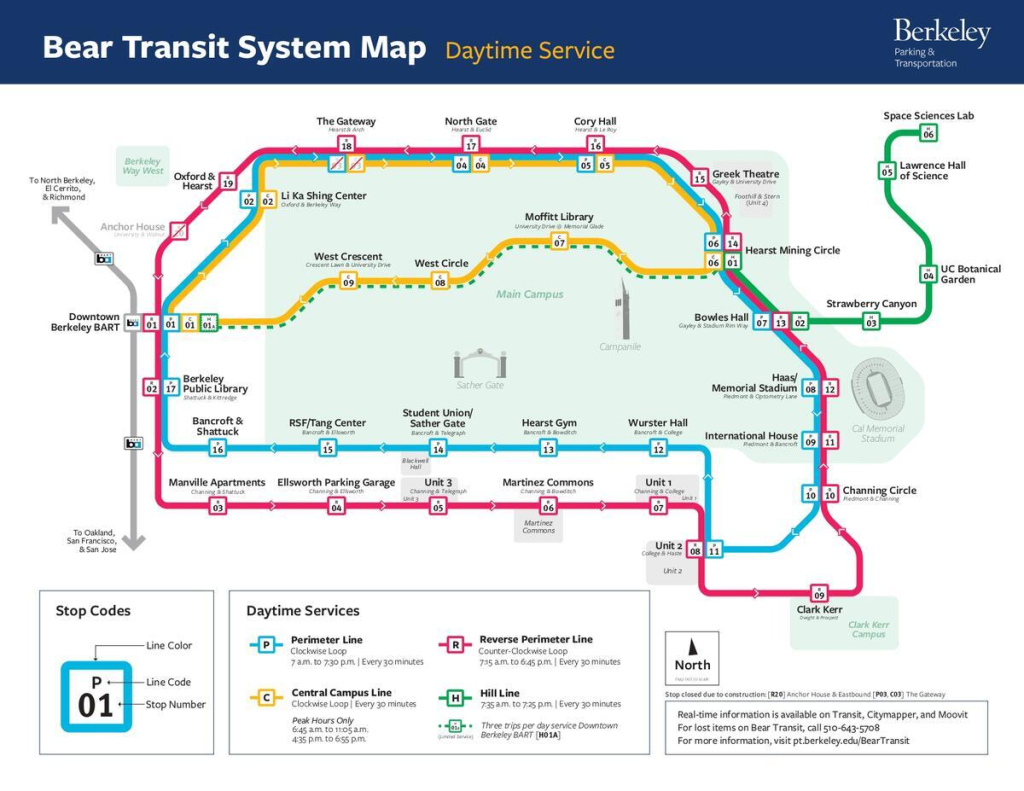
Bear Transit is UC Berkeley’s own bus system, run by Parking & Transportation Services. It’s free to ride with a valid Cal 1 Card and serves the campus, the surrounding student housing areas, and the hills above campus where many graduate residences and labs are.
The lines you’ll use most often as an international student:
The Central line runs through the heart of campus and connects to the Downtown Berkeley BART station — useful if you live near campus but need to catch BART out to San Francisco or Oakland.
The Hill Service lines run from campus up to the Lawrence Berkeley National Laboratory and Lawrence Hall of Science. If you’re a graduate student in physics, engineering, or any field with affiliations to LBNL, you’ll know this line by week two.
The Southside loop covers the streets where most off-campus housing is — Telegraph, Channing, Durant, Bancroft. Useful when it’s raining, when you have books to carry, or when the walk feels long.
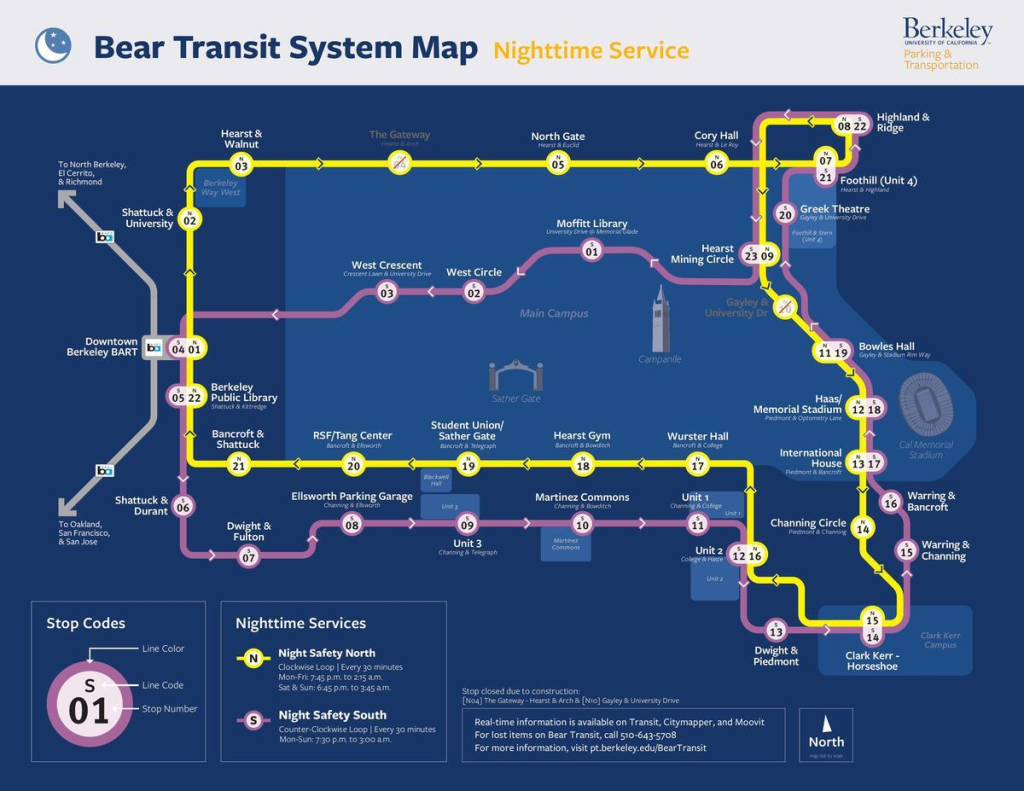
Bear Transit also runs the Night Safety Shuttle, which provides door-to-door pickup within the campus zone from 2:30am to 5:30am — after Bear Walk hours end. Same free Cal 1 Card requirement. Save the number before classes start.
Routes, hours, and a live map are at pt.berkeley.edu/
AC Transit and the EasyPass: free unlimited buses across the East Bay
This is the single most valuable piece of information in this guide, and it’s the one most international students don’t discover until their second semester.
Berkeley students get unlimited free rides on the entire AC Transit bus network as part of their student fees. It’s called the Class Pass (officially the EasyPass program), and it’s loaded directly onto your Cal 1 Card. You don’t sign up for it. You don’t pay extra for it. You don’t carry a separate card. You walk up to any AC Transit bus, tap your Cal 1 Card on the reader, and ride for free.
AC Transit covers all of Berkeley, Oakland, Emeryville, Albany, Alameda, and most of the East Bay — over 100 routes serving roughly 1.5 million people. The routes that matter most to a UC Berkeley student:
Line 51B runs north-south through campus, connecting Berkeley to Rockridge and downtown Oakland. It’s the workhorse route for grocery runs, Oakland trips, and getting to BART stations along College Avenue.
Line 6 runs along Telegraph Avenue from campus to Downtown Oakland. The fastest way to Oakland’s Chinatown and Asian grocery stores.
Line 7 connects Berkeley to East Oakland.
Line 18 runs along Solano Avenue, the main shopping and restaurant strip in north Berkeley.
The Transbay buses (Lines F, FS, NL, NX, NX1, NX4, etc.) connect Berkeley to San Francisco directly. The F line goes from Downtown Berkeley to the Transbay Terminal in SF for the price of a regular AC Transit ride — which for you means free.
Download the Transit app (free, available in every app store) before classes start. It shows you real-time arrivals for every AC Transit and Bear Transit bus, and works in every Bay Area transit system. It’s significantly better than Google Maps for actual on-the-ground bus catching.
BART: getting out of Berkeley
BART (Bay Area Rapid Transit) is the regional heavy rail system. It’s not free — you pay per ride — but it’s how you get to San Francisco, Oakland, the East Bay suburbs, and both Bay Area airports.
Berkeley has three BART stations:
Downtown Berkeley BART is the main one, two blocks from Shattuck Avenue and walkable from most central student housing. Trains here go to San Francisco (Embarcadero, Montgomery, Powell, Civic Center) in roughly 25–30 minutes.
North Berkeley BART is up at Sacramento Street, useful if you live in the northern parts of Berkeley or in Albany.
Ashby BART is south of campus near the Berkeley-Oakland border. If you live at 3228 Adeline or anywhere along Adeline Street, this is your station — and it’s a 5-minute BART ride to Downtown Berkeley if walking back from campus at night feels long.
You pay BART with a Clipper card — the universal Bay Area transit card. You can get one at any BART station, at most Walgreens, or by adding it to Apple Pay or Google Pay on your phone (which is what most students do). Load $20–40 to start; you’ll spend about $4–6 per BART trip to San Francisco. Refill as needed.
Note: AC Transit is also Clipper-compatible, but for AC Transit specifically you use your Cal 1 Card (which has the EasyPass loaded). You only use Clipper for AC Transit if you’re outside the EasyPass zone, which essentially never happens.
Biking: the underrated option
Berkeley is one of the most bike-friendly cities in California. Most major streets have bike lanes, the campus itself has bike paths, and a meaningful share of the student population gets everywhere on two wheels. If you’re confident on a bike and you live more than 10 minutes from campus by foot, getting a bike will dramatically expand your effective range.
Where to buy a bike
A used commuter bike from Facebook Marketplace runs $80–200 and will get you through your degree. End-of-semester listings (late May, late August) are the best deals. Missing Link Cooperative, a worker-owned bike shop on Shattuck near campus, sells used bikes and does affordable tune-ups. Pegasus Bicycle Works on Solano sells new commuter bikes in the $400–700 range and provides free tune-ups for life on new bike purchases.
Lock it like it’ll get stolen, because it will
Berkeley has a serious bike theft problem. A cable lock will not protect your bike. You need a U-lock at minimum — Kryptonite Evolution Mini or similar, $50–80. Pair it with a secondary cable to lock the front wheel. Always lock the frame, never just the wheel. Register your bike free at bikeindex.org and bike.berkeley.edu — registered bikes are much more likely to be recovered if stolen.
Helmets and safety
California law doesn’t require adult cyclists to wear helmets, but you should anyway — Berkeley has a lot of car-bike intersections. A $40 helmet from Target is fine. Get bike lights too (front white, rear red), required by law after dark.
Where to park on campus
Campus has bike racks at every major building. The biggest covered bike garages are at the Recreational Sports Facility (RSF) and at the BART stations. Some TBG properties have indoor bike storage — check with your community manager.
Rideshare (Uber and Lyft)
For evenings out, grocery runs with heavy bags, late-night returns when BART has stopped running, and airport trips with luggage, Uber and Lyft are your default options. Both apps work essentially identically. Download one of them before you arrive in Berkeley, link a payment method (credit card or debit card; international cards generally work but check before you fly), and you’re set.
Typical fares from central Berkeley:
- Downtown Berkeley to anywhere else in central Berkeley: $7–12
- Berkeley to downtown Oakland: $15–22
- Berkeley to San Francisco (depending on neighborhood): $30–55
- Berkeley to SFO airport: $50–75 (BART is dramatically cheaper if you have time)
- Berkeley to OAK airport: $30–45
If you’re cost-sensitive, both apps offer pooled/shared options (UberX Share, Lyft Shared) at 20–30% lower fares — slower because the car picks up other riders, but useful for non-urgent trips.
When you actually need a car: Zipcar and Getaround
A handful of trips genuinely benefit from a car: a Costco run for bulk groceries, an IKEA Emeryville run for furniture, a day trip to Point Reyes or Muir Woods, a weekend to Lake Tahoe with friends.
For these, you have two practical options without owning a car:
Zipcar has multiple vehicles parked directly on the UC Berkeley campus, in dedicated student-discounted parking spots. UC students get a discounted membership (typically around $25/year vs. $7/month standard membership), and rentals run $9–15/hour or roughly $80–100 for a full day, with gas and insurance included. You reserve through the app, walk to the car, unlock with the app, drive, return to the same spot.
Getaround is a peer-to-peer car-sharing service — regular Bay Area residents rent out their personal cars by the hour. Generally cheaper than Zipcar, more cars available, but the experience varies by host. Useful for spontaneous trips when Zipcar is booked up.
Note: you need a driver’s license to rent through either service. Most international students don’t get a California driver’s license unless they plan to stay long-term — your home-country license, if from a country with reciprocity (most of Europe, much of Asia), works for short-term rentals. Verify with Zipcar before signing up. International Driving Permits help in some cases. Without a license, you stay in the rideshare / transit world, which is fine.
Getting from the airport on arrival day
You’re landing at SFO or OAK with two suitcases and going to your apartment for the first time. Your options:
From SFO (San Francisco International Airport)
BART is the cheapest and most reliable. Walk from your terminal to the SFO BART station (signs everywhere), tap a Clipper card or buy a ticket from a kiosk ($10–12 to Downtown Berkeley), and ride about 70 minutes including a transfer (typically at Balboa Park or 19th Street Oakland depending on time of day). Trains run roughly every 15 minutes.
Uber or Lyft from SFO to Berkeley is faster (35–55 minutes depending on traffic) but expensive ($50–75) — worth it if you’re arriving very late at night or with more luggage than you can comfortably manage on BART.
From OAK (Oakland International Airport)
BART is dramatically more convenient from OAK than from SFO. Take the AirBART Connector (the small tram that runs every few minutes from the airport terminal to the Coliseum BART station), then BART north to Downtown Berkeley. Total time roughly 30–35 minutes, total cost about $12.
Uber or Lyft from OAK to Berkeley runs $30–45 and takes 20–30 minutes.
If you’re arriving with more luggage than you can lift on BART (typical for a fall move-in), Uber/Lyft is probably worth the extra money for the first trip. After that, plan to use BART for every airport trip.
Day trips and weekends
A short list of where students go from Berkeley and how to get there:
San Francisco: BART to Embarcadero, Powell, or Civic Center. ~30 minutes, $4–6.
Downtown Oakland and Oakland Chinatown: AC Transit Line 6 or BART to 12th Street/Oakland City Center. Free or $2.50.
Stanford and Palo Alto: BART to Millbrae, transfer to Caltrain. ~90 minutes total.
Marin County (Sausalito, Mill Valley): BART to Embarcadero, then Golden Gate Ferry from the Ferry Building. Beautiful day trip, ~$15 each way for the ferry.
Napa and Sonoma wine country: requires a car, or join an organized tour bus (~$80–120 for a day).
Point Reyes National Seashore: requires a Zipcar or organized hiking group.
Yosemite National Park: take the YARTS bus from Merced (Amtrak from Berkeley to Merced, then YARTS), or split a Zipcar for a weekend with friends.
Lake Tahoe: Greyhound or Amtrak Thruway buses run from the East Bay to Truckee and Reno. Most students rent a Zipcar with friends for ski weekends.
Your starter transportation toolkit (do these before classes start)
A short checklist of setup tasks for your first week in Berkeley:
- Pick up your Cal 1 Card during orientation. The EasyPass for AC Transit is loaded onto it automatically.
- Add a Clipper card to Apple Wallet or Google Pay, or buy a physical card at any BART station. Load $20–40 to start.
- Download the Transit app for real-time bus and BART arrivals.
- Download Uber and/or Lyft and link a payment method.
- Save these phone numbers: (510) 642-WALK (Bear Walk), (510) 642-3175 (Bear Transit dispatch).
- If you plan to bike: buy a U-lock (Kryptonite Evolution Mini or stronger), front and rear lights, and register your bike at bikeindex.org.
That’s the entire setup. With those six items, you can move yourself anywhere in the East Bay or the broader Bay Area without ever needing to learn to drive, sign up for car insurance, or hunt for parking.
Frequently asked questions
Do I need a driver’s license to live in Berkeley as an international student?
No. You can complete your entire degree at UC Berkeley without ever driving. A license is only required if you want to rent cars (Zipcar, Getaround, traditional rental agencies). For everything else — BART, AC Transit, Bear Transit, biking, walking, rideshare — no license is needed.
Is AC Transit really free for Berkeley students?
Yes, with limits. The EasyPass / Class Pass is loaded onto your Cal 1 Card as part of your student fees, and gives you unlimited free rides on the entire AC Transit system (including Transbay buses to San Francisco). It’s active for the full academic year for any student enrolled in 6+ units.
Is BART safe at night?
Generally yes. BART runs until midnight on weekdays, slightly later on Saturday, and about 8pm on Sunday. The Downtown Berkeley and North Berkeley stations are well-trafficked. Use normal city-at-night habits — be aware of your surroundings, hold your phone close, and travel with a friend when possible. If you’re returning to Berkeley after midnight, your options are AC Transit’s Owl-night service, an Uber/Lyft, or the Berkeley Night Safety Shuttle if you’re already near campus.
How do I get to and from SFO with a lot of luggage?
For move-in day (or move-out day), Uber XL or Lyft XL is usually worth the cost — both let you carry more luggage than a regular sedan, and the door-to-door service eliminates the BART transfer hassle. For everyday travel after you’re settled in, BART is cheap, fast, and easy.
Are e-bikes and e-scooters allowed in Berkeley?
Yes. Lime and other shared e-scooter/e-bike services operate in Berkeley, and many graduate students own personal e-bikes for commuting from further-out neighborhoods. California law requires helmets for riders under 18, and most operators recommend them at all ages. E-bikes are not allowed on campus paths intended for pedestrians only.
Is Berkeley walkable in winter?
Yes. Berkeley winters are mild — temperatures rarely drop below 40°F, and it never snows. The challenge is rain: November through March bring regular rain, occasionally heavy. A waterproof jacket and waterproof shoes solve 90% of the problem. The other 10% is solved by knowing when to take an Uber.
Do TBG communities have bike storage?
Many do, in various configurations — secure indoor rooms at some properties, outdoor covered racks at others. Check directly with your community manager when you tour or sign your lease.
Final thought
The students who thrive at Berkeley without a car aren’t the ones who tolerate it — they’re the ones who realize quickly that not having a car is actually an upgrade. You save $500/month. You walk through one of the most beautiful college towns in America twice a day. You read on the BART platform instead of fighting bridge traffic. And when you do need a car, it’s a Zipcar reservation away.
Set up the toolkit during your first week, take a slow walk through your new neighborhood, and let yourself get genuinely lost on AC Transit one Saturday — you’ll know the city better in two weeks than most students who drive learn in two years.
Welcome to Berkeley. Go Bears.
Looking for an apartment near UC Berkeley that’s walking distance to Sather Gate? Every TBG community sits within Bear Walk’s coverage area and steps from BART, AC Transit, and Bear Transit routes. Browse our furnished and unfurnished options or get in touch with our team for a tailored recommendation.