
What UC Berkeley Housing Doesn’t Tell Transfer Students
Congratulations on your admission to Cal. You’ve earned it. Now comes the part the welcome packet glosses over: figuring out where you’re actually going to live.
UC Berkeley’s official housing site is a useful starting point, but transfer students consistently tell us the same thing after move-in week: “I wish someone had told me this earlier.” If you’re a transfer headed to Berkeley this fall, here’s what the brochures and FAQ pages tend to leave out.
The “transfer housing guarantee” is narrower than it sounds
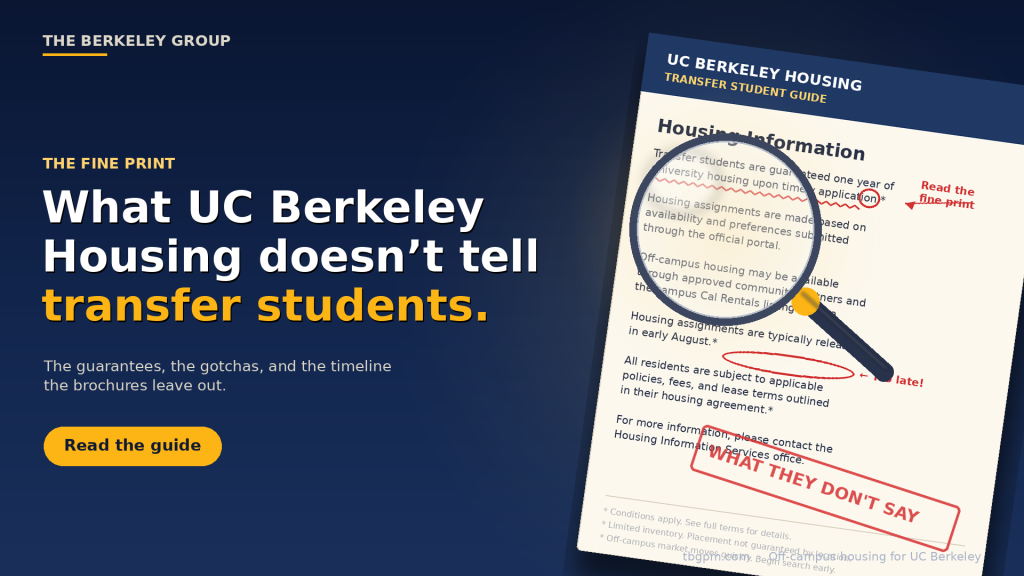
Berkeley guarantees one year of university housing to new transfer students who apply by the deadline. That’s real, and it’s better than what most UC campuses offer. But read the fine print:
The guarantee is for a space, not your preferred space. Transfers are typically placed in apartment-style residences that skew older, further from central campus, and often in shared rooms. If you were imagining a single in a building near Sproul, recalibrate.
The guarantee also covers one academic year. After that, you’re on the open market with everyone else — and the market in Berkeley does not wait around.
The off-campus market moves faster than you think
Most transfers assume they’ll figure out housing over the summer. By summer, the good options are gone.
In Berkeley, leases for the following fall start getting signed as early as November and December of the prior year. By February and March, the inventory closest to campus is heavily picked over. By May, you’re choosing from what’s left, which is often what nobody else wanted.
If you’re starting at Cal in fall and plan to live off-campus for year two, start looking in December or January at the latest. Yes, that’s seven to nine months ahead. Yes, that’s normal here.
Most leases are twelve months, not nine
Almost every off-campus apartment near campus is on a 12-month lease, August to August. The academic year is nine months. That gap matters.
You have three real options:
- Pay for the three summer months you’re not using
- Sublet, which most leases technically allow only with landlord approval
- Find one of the rare 9- or 10-month “academic year” leases (limited supply, often priced at a premium)
Budget for twelve months of rent unless you have a confirmed sublet plan.
“Walking distance” means different things in Berkeley
Listings will tell you a unit is “walking distance to campus.” Berkeley is hilly. Northside, Southside, Downtown, and the Elmwood all read similarly on a map but feel completely different in practice.
A few things to know before signing:
- Southside (south of campus, around Telegraph) is dense, social, and central, but loud and the building stock is older
- Northside is quieter, closer to engineering and the natural sciences, but limited dining and nightlife
- Downtown has the BART station, more new construction, and good food, but you’re walking uphill to most classes
- Elmwood and Claremont are beautiful and quiet — and a real walk or a bus ride from campus
If your major is concentrated in one part of campus (Haas, Engineering, the Life Sciences), the right neighborhood saves you 30–40 minutes of walking every single day.
The hidden monthly costs nobody quotes
The rent number on the listing is rarely what you actually pay. Plan for:
- Utilities (PG&E, water, sometimes garbage) — often $40–$120 per person per month
- Internet — $30–$60 per unit, split among roommates
- Renters insurance — required by most landlords, $10–$20 per month
- Laundry — many older buildings have coin-op or card-op machines, not in-unit
- Parking — if you have a car, $100–$300 per month, and street parking near campus is brutal
Factor an extra $100–$200 per person per month onto whatever rent you see advertised.
The application process favors prepared applicants
Berkeley’s rental market is competitive enough that you’re effectively interviewing for an apartment. Landlords and property managers see dozens of applications for desirable units. The students who get them tend to show up with:
- Proof of income or a co-signer with verifiable income
- Recent pay stubs or financial aid award letters
- A credit report (or, if you don’t have credit yet, a co-signer who does)
- References (a previous landlord or RA is ideal)
- A filled-out application ready to submit on the spot
Walking into a tour with a folder of documents puts you ahead of 80% of other applicants. Coming back tomorrow to “send the paperwork over” often means the unit is gone.
Co-ops, Greek housing, and theme houses are real options
Cal’s housing conversation tends to default to “dorms or apartments.” There’s a third category most transfers miss:
- The Berkeley Group property management offers off-campus housing that are, in some cases, closer than actual Berkeley dorms. They’re also fully-furnished and competitively priced, as compared to on-campus housing.
- The Berkeley Student Cooperative (BSC) runs around 17 houses and apartments with significantly cheaper rent in exchange for shared work hours. Different vibe in each house — worth touring.
- Greek housing is open to members and often costs less than equivalent apartments, with meals included
- Theme houses and language houses through campus housing offer community around an interest or identity
These don’t fit everyone, but they’re worth knowing exist before you commit to a 12-month lease somewhere.
Berkeley has strong tenant protections — know them
Berkeley’s Rent Stabilization Ordinance is one of the strongest in the country. It limits rent increases, requires just cause for eviction, and gives tenants real recourse when landlords don’t follow the rules.
A few caveats: the ordinance does not cover all units (newer construction is often exempt), and student-specific arrangements can have different terms. But if something feels off — a landlord refusing to return a deposit, a sudden eviction notice, an illegal rent increase — Berkeley’s Rent Board is a real resource and they take tenant complaints seriously.
The takeaway
Transfer students arrive at Cal with two years to make the most of one of the best universities in the world. Don’t spend the first semester scrambling for housing or the second year overpaying for a unit you settled for in a panic.
Start early. Ask questions the FAQ doesn’t answer. Tour places before you sign. And remember: in Berkeley, the students who do well in the housing market are the ones who treated it like a project — not an afterthought.
Welcome to Cal. You’re going to love it here once the lease is signed.